1443 - Minimum Time to Collect All Apples in a Tree (Medium)
Problem Link
https://leetcode.com/problems/minimum-time-to-collect-all-apples-in-a-tree/
Problem Statement
Given an undirected tree consisting of n vertices numbered from 0 to n-1, which has some apples in their vertices. You spend 1 second to walk over one edge of the tree. Return the minimum time in seconds you have to spend to collect all apples in the tree, starting at vertex 0 and coming back to this vertex.
The edges of the undirected tree are given in the array edges, where edges[i] = [ai, bi] means that exists an edge connecting the vertices ai and bi. Additionally, there is a boolean array hasApple, where hasApple[i] = true means that vertex i has an apple; otherwise, it does not have any apple.
Example 1:
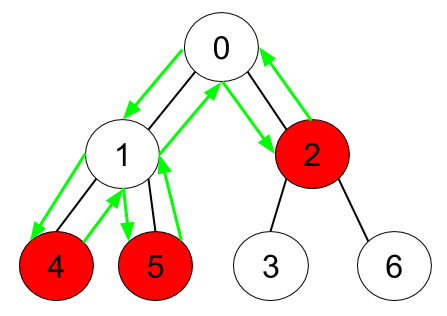
Input: n = 7, edges = [[0,1],[0,2],[1,4],[1,5],[2,3],[2,6]], hasApple = [false,false,true,false,true,true,false]
Output: 8
Explanation: The figure above represents the given tree where red vertices have an apple. One optimal path to collect all apples is shown by the green arrows.
Example 2:
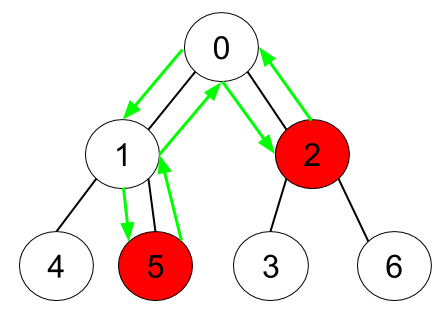
Input: n = 7, edges = [[0,1],[0,2],[1,4],[1,5],[2,3],[2,6]], hasApple = [false,false,true,false,false,true,false]
Output: 6
Explanation: The figure above represents the given tree where red vertices have an apple. One optimal path to collect all apples is shown by the green arrows.
Example 3:
Input: n = 7, edges = [[0,1],[0,2],[1,4],[1,5],[2,3],[2,6]], hasApple = [false,false,false,false,false,false,false]
Output: 0
Constraints:
1 <= n <= 1e5edges.length == n - 1edges[i].length == 20 <= ai < bi <= n - 1fromi < toihasApple.length == n
Approach 1: DFS + Backtracking
- Let's make another array out of
edgesand call itgraph, where each elementgraph[i]contains neighbour edges. - Perform DFS + backtracking to calculate the minimum time in second using
graph.
Time Complexity:
Space Complexity:
class Solution:
    def minTime(self, n: int, edges: List[List[int]], hasApple: List[bool]) -> int:
        # Edge case: no apples - just return 0
        if len(list(filter(lambda edge: edge, hasApple))) == 0:
            return 0

        # Create a graph using edges
        graph: List[List[int]] = [[] for _ in range(n)]
        for edge_a, edge_b in edges:
            if edge_b not in graph[edge_a]:
                graph[edge_a].append(edge_b)
            if edge_a not in graph[edge_b]:
                graph[edge_b].append(edge_a)

        def dfs(current: int, parent: int) -> int:
            sub_total = 0

            for child in graph[current]:
                # If child == parent, do nothing to prevent going back to the parent
                # If not, this should be an index of a child edge
                # -> perform dfs and add the result to sub total
                if child != parent:
                    sub_total += dfs(child, current)

            # If the edge has apples in it, or  if children has apples,
            # we need to visit it -> add extra 2
            if hasApple[current] or 0 < sub_total:
                return sub_total + 2
            # Else, this edge has no apples, or no children that have apples.
            # So we don't have to visit this edge -> just return 0
            return 0

        # In this approach dfs() assumes there is always a parent edge connected to it.
        # But since root doesn't have it - the result has 2 extra unit of seconds.
        # Therefore subtract 2 from the result of dfs()
        return dfs(0, -1) - 2